
Why choose Vitamin C Serum Manufacturing in a crowded skincare market? Consumer demand is moving toward targeted, evidence-based products. Grand View Research valued the global skincare products market at approximately USD 155.7 billion in 2023. It also projects continued growth through 2030. Circana reported growth in U.S. prestige skincare sales during 2023, showing sustained interest in high-performance formulations.
Vitamin C remains attractive because it supports antioxidant protection and collagen-related skin benefits. A review in the Journal of Clinical and Aesthetic Dermatology describes topical vitamin C as a valuable cosmetic ingredient. However, the ingredient is not simple to handle. Light, oxygen, water, and heat can reduce its stability. That is where professional manufacturing matters. Good manufacturing practice, controlled filling, and validated stability testing can protect product quality from the laboratory to the bathroom shelf.
Packaging matters too.
Amber airless bottles, measured filling, and low-oxygen production environments may help limit degradation. ISO 22716 guidance also provides a recognized framework for cosmetic production and quality control. Experienced manufacturers can adjust pH, select compatible ingredients, and monitor microbial safety. These steps support reliable performance and clearer documentation.
Still, no supplier should promise perfect results. Vitamin C formulas can change color over time. Some claims remain difficult to prove without product-specific testing. Brands should review stability data, batch records, ingredient specifications, and independent laboratory results before choosing a partner. Vitamin C Serum Manufacturing is therefore not merely a production decision. It is a quality, evidence, and trust decision.
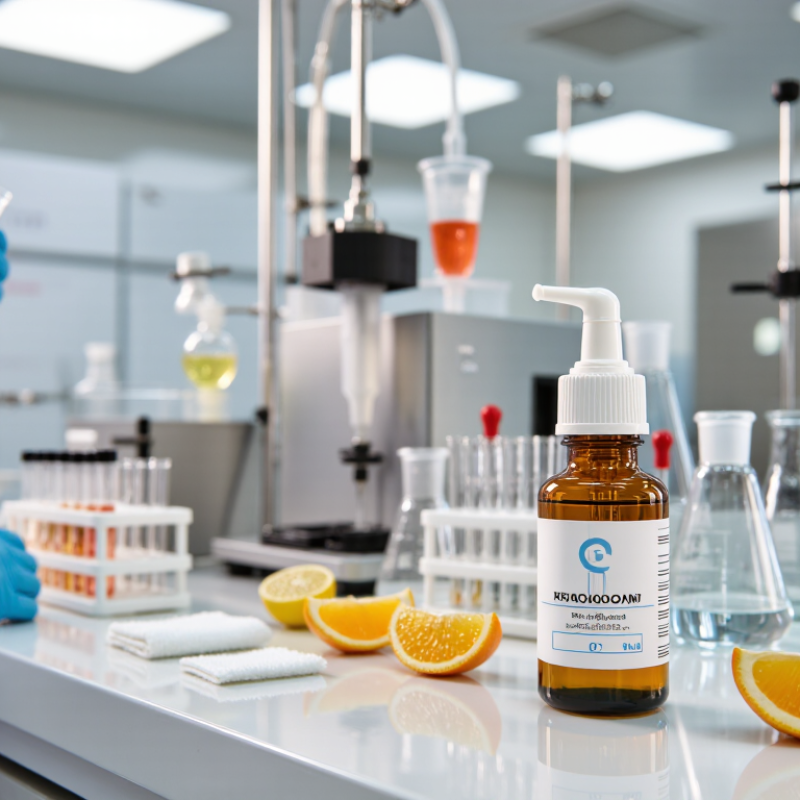
Understanding Vitamin C Serum Manufacturing
Vitamin C serum manufacturing begins with ingredient stability, not attractive packaging. Grand View Research estimates the global vitamin C serum market could reach about USD 1.8 billion by 2030. This growth reflects demand for brightening and antioxidant skincare. However, market growth does not guarantee formula quality. Pure L-ascorbic acid can oxidize when exposed to oxygen, light, heat, or water. The serum may change from clear to yellow or brown. That visible change matters.
Professional manufacturers control pH, oxygen exposure, temperature, and filling conditions. A low-pH formula often improves L-ascorbic acid performance, but it may increase skin discomfort. This is where practical formulation experience becomes important. Manufacturing teams commonly evaluate viscosity, color, odor, microbial quality, and active content during stability testing. ISO 22716 provides internationally recognized guidance for cosmetic good manufacturing practices. It covers production, storage, quality control, and documentation.
Packaging requires equal attention. Airless pumps and opaque containers can reduce light and oxygen exposure. Yet, no package solves every problem. Repeated opening, warm bathrooms, and long shipping periods can still affect performance. Circana reported that U.S. prestige beauty sales grew 14% in 2023, showing strong consumer spending in higher-value skincare. That opportunity also raises expectations. A reliable manufacturer should provide batch records, stability evidence, and realistic shelf-life claims. Some formulas still fail after months of testing. That failure is useful. It reveals what needs improvement before consumers discover it.
| Data Dimension | Typical Specification or Range | Why It Matters in Manufacturing |
|---|---|---|
| Primary Active Ingredient | L-Ascorbic Acid or a Vitamin C Derivative | L-Ascorbic acid is the direct form of vitamin C, while derivatives such as sodium ascorbyl phosphate, magnesium ascorbyl phosphate, ascorbyl glucoside, and 3-O-ethyl ascorbic acid are selected when improved formulation stability or skin compatibility is required. |
| Vitamin C Concentration | Approximately 5%–20% for L-ascorbic acid formulas | Lower concentrations are commonly used for introductory or sensitive-skin products. Higher concentrations may provide a stronger product profile but require tighter control of pH, oxidation, packaging, and consumer-use instructions. |
| Formula pH | Usually about pH 2.5–3.5 for L-ascorbic acid serums | An acidic environment helps maintain the solubility and performance of L-ascorbic acid. The final pH must also be evaluated for skin tolerability, preservative performance, and product stability. |
| Derivative-Based Formula pH | Often approximately pH 5.0–7.0, depending on the derivative and formula | Vitamin C derivatives can allow a broader pH range than pure L-ascorbic acid. The exact target should be established through compatibility, stability, and safety testing rather than by concentration alone. |
| Oxidation Control | Low-oxygen processing, controlled light exposure, and compatible antioxidants | Vitamin C can degrade when exposed to oxygen, heat, light, or unsuitable metals. Manufacturing controls may include minimizing headspace, reducing processing time, and using compatible chelating or antioxidant systems where appropriate. |
| Recommended Packaging | Opaque or amber airless pump, sealed pump bottle, or other low-oxygen packaging | Packaging should limit exposure to air and light. Transparent dropper bottles may increase oxygen exposure during repeated use, so packaging selection should be confirmed through real-time and accelerated stability studies. |
| Common Supporting Ingredients | Humectants, water or water-based solvents, texture modifiers, chelating agents, and preservatives when required | Supporting ingredients help control viscosity, skin feel, moisture retention, microbial protection, and formula stability. Each component must be checked for compatibility with the selected vitamin C form and target pH. |
| Batch Manufacturing Controls | Controlled temperature, validated mixing sequence, accurate weighing, and documented batch records | Consistent processing helps maintain uniform active concentration, appearance, viscosity, and pH from batch to batch. Sensitive formulas may require shorter processing times and protection from excessive heat and light. |
| In-Process Quality Checks | Appearance, odor, pH, viscosity, specific gravity, and homogeneity | In-process testing can identify problems before filling, including incomplete dispersion, unexpected color change, pH drift, or viscosity variation. |
| Finished Product Testing | Assay or active-content testing, microbial limits, preservative effectiveness where applicable, and package compatibility | Finished-product testing verifies that the serum meets its specifications and remains suitable for use. The exact testing program depends on the formula, claims, market, and regulatory requirements. |
| Stability Evaluation | Real-time and accelerated studies under defined temperature, humidity, light, and packaging conditions | Stability studies help determine expected shelf life, storage instructions, packaging suitability, color changes, pH drift, viscosity changes, and retention of the vitamin C active. |
| Color Monitoring | Clear to pale yellow may occur; progressive yellow, orange, or brown discoloration can indicate oxidation | Color should be evaluated together with active-content and stability data. A color change alone does not fully determine product safety or performance, but it is an important quality indicator. |
| Microbiological Protection | Preservative system and packaging selected according to formula water activity and usage conditions | Water-based serums can support microbial growth if not properly preserved. Microbial limits testing and, where appropriate, preservative efficacy testing support product safety and quality. |
| Manufacturing Standard | Cosmetic Good Manufacturing Practices, such as ISO 22716-based procedures where applicable | Good Manufacturing Practices support controlled facilities, sanitation, personnel training, traceability, documentation, deviation management, and consistent product quality. |
| Customization Options | Active form, concentration, texture, fragrance-free profile, packaging format, and target skin-feel | Professional manufacturing allows the formula to be adapted to different market positions and consumer preferences while maintaining defined quality, safety, stability, and regulatory requirements. |
| Key Manufacturing Advantage | Repeatable quality with controlled formulation and packaging performance | Choosing specialized vitamin C serum manufacturing can improve batch consistency, oxidation management, quality documentation, scale-up control, and the ability to validate the finished product before commercialization. |
Oxygen, light, heat, and water can oxidize pure vitamin C. Clear serum may turn yellow or brown. Color change deserves investigation.
They should test ingredient identity, vitamin C concentration, pH, viscosity, odor, and microbial limits. Heavy-metal testing also matters. Every batch needs traceable records.
A lower pH can support pure vitamin C performance. It may also increase stinging or redness. Better performance is not always better comfort.
Opaque bottles and airless pumps can reduce light and oxygen exposure. They are not perfect. Warm bathrooms and repeated opening still create risks.
Ask for accelerated and real-time stability results. Testing should examine color, odor, pH, active content, and microbes. Some formulas still fail after months.
Request current certificates, batch records, test methods, and filled-package testing. Check whether the final bottle was tested, not only the raw ingredients.
Observe color, scent, absorption, texture, and pump performance. Store it under normal conditions. A small leak can reveal a larger packaging problem.
No. Skin sensitivity, storage habits, shipping temperatures, and formula differences affect results. Clear communication should include these limits. Promises need caution.
Vitamin C Serum Manufacturing is a specialized process that combines cosmetic science, ingredient expertise, and careful production management to create stable, effective skincare products. From selecting suitable forms of vitamin C to balancing supporting ingredients such as antioxidants, moisturizers, and soothing agents, every formulation decision can influence product performance, texture, shelf life, and user experience. A well-planned manufacturing process also considers packaging compatibility and protection from light, air, and moisture.
Quality control is essential throughout production, including raw material inspection, accurate weighing, hygienic processing, stability evaluation, and finished-product testing. Manufacturers should follow consistent quality systems and applicable cosmetic production standards to help ensure safety, reliability, and batch-to-batch consistency. When choosing the right manufacturing partner, businesses should evaluate formulation capabilities, production capacity, testing procedures, communication, documentation, and experience with vitamin C products. A dependable manufacturer can support efficient development and help transform a well-designed serum concept into a consistent, market-ready product.